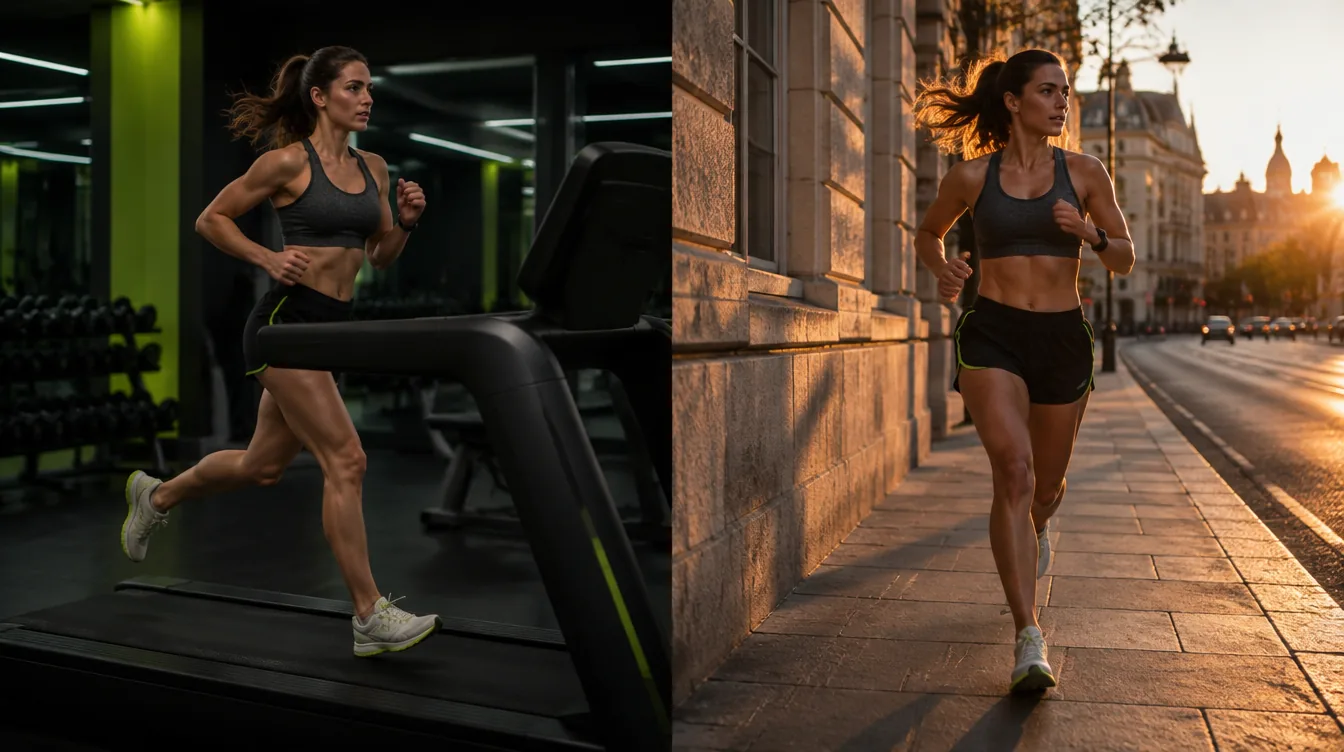
Both build fitness. Outdoors you work a little harder because there's no belt moving you and no still air; that's why many runners set the treadmill to a 1% incline so the effort feels closer to running outside. The best plan is to use both depending on your week and the weather.
Main differences
| Treadmill | Outdoors | |
|---|---|---|
| Effort at the same pace | Slightly lower | Slightly higher (wind, terrain) |
| Pace control | Exact | Varies with hills and lights |
| Impact | Belt with some cushioning | Depends on the surface |
| Weather and safety | Always the same | Heat, rain, traffic |
| Motivation | Can get boring | More variety |
When the treadmill makes sense
- Intervals at an exact pace.
- Bad weather, strong heat or running at night.
- Coming back from an injury with full control.
When outdoors makes sense
- If your 5K or 10K race is outside.
- To train real hills, turns and pace changes.
- To stay entertained on long runs.
1%
incline to feel like running outside
2
surfaces to vary the impact
If your goal race is on the road, do at least half your kilometers outside.
Learn to judge your effort with our running pace guide.