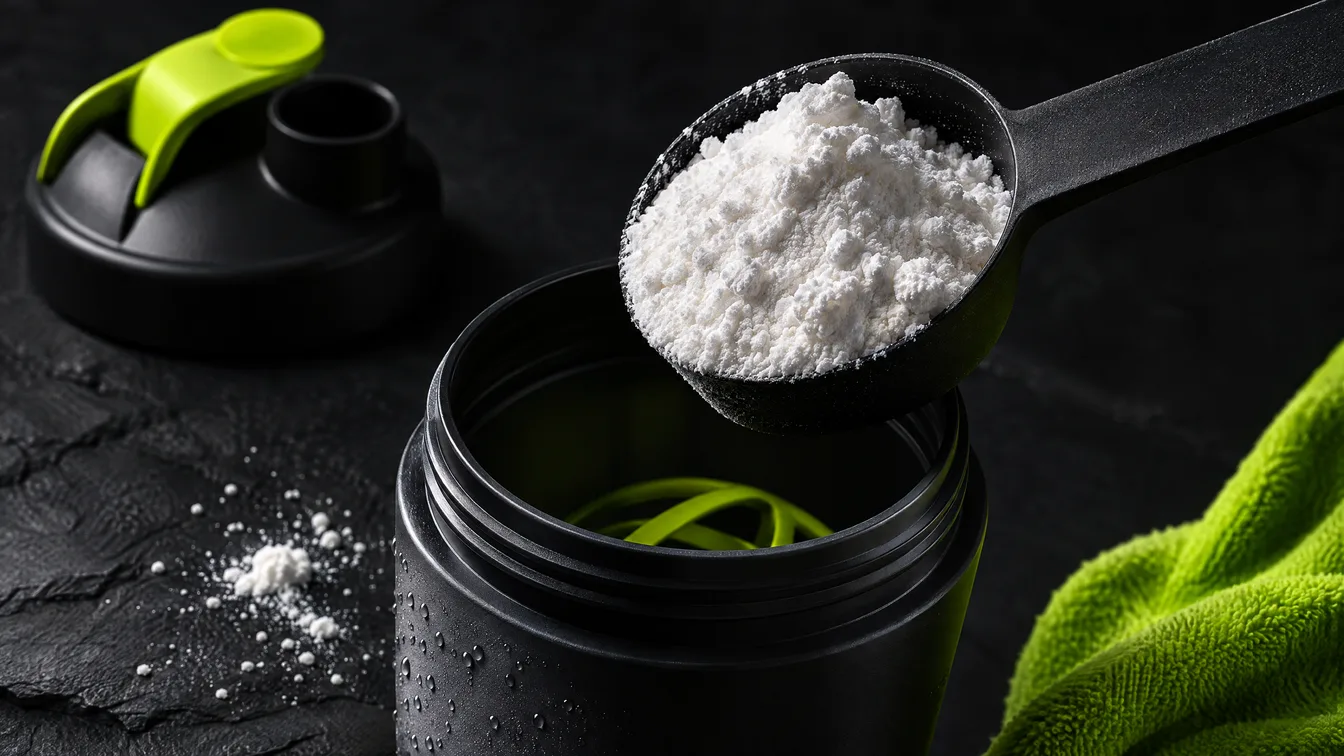
How much creatine per day? For most people, 3 to 5 g of creatine monohydrate daily, every day, at any time. You don't need a loading phase: at 3 to 5 g your muscles fill up in about 3 to 4 weeks. Loading (about 20 g a day for 5 to 7 days) only speeds that up.
Creatine is the most studied sports supplement there is. It helps you gain strength and muscle when you lift, it's cheap and, in healthy people, recommended doses are considered safe. Below you'll find the dose for your situation, how to take it and the truth about the most common myths.
What creatine is and what it does
Your body already makes creatine, and you also get it from meat and fish. Most of it is stored in your muscles, where it helps produce quick energy for short, hard efforts: a heavy set of squats, a sprint, a jump.
A typical diet with meat gives you 1 to 2 g a day, and your body replaces 1 to 3 g daily to keep its stores. Supplementing tops those stores off. The result? You can squeeze out one or two more reps per set, and week after week that turns into more strength and more muscle. That's why it works best alongside progressive overload.
How much creatine to take per day
| Your situation | How much | For how long |
|---|---|---|
| Standard (no loading) | 3 to 5 g a day | Every day, no breaks |
| You want faster results (loading) | 0.3 g per kg a day (about 20 g), in 4 doses of 5 g | 5 to 7 days, then 3 to 5 g daily |
| Scaled to body weight | 0.1 g per kg (about 0.045 g per lb) a day | Every day |
| Example: 70 kg (154 lb), no loading | 5 g a day (one level teaspoon) | Every day |
If you weigh well over 90 kg (200 lb) or you're vegetarian, you can go to the top of the range (5 g or 0.1 g per kg). Taking more than that every day doesn't give better results: the excess is simply excreted.
How and when to take it
- Any time of day. Some studies suggest a small edge from taking it after training, but the finding isn't consistent. What matters is taking it every day, rest days included.
- With whatever you like. Water, your protein shake, juice or your morning oatmeal. Pairing it with a meal makes it easier to remember.
- Monohydrate, period. It's the most studied form and the cheapest. Other forms (HCl, "buffered", liquid) haven't been shown to work better.
- No cycling. You don't need weeks off. If you miss a day, just take your normal dose the next day.
If you do a loading phase, split the 20 g into 4 doses to avoid an upset stomach.
7 creatine myths
| Myth | What the evidence says |
|---|---|
| "It damages your kidneys" | In healthy people, studies find no harm at recommended doses. If you already have kidney disease, talk to your doctor first. |
| "It's a steroid" | No. It's a compound your body makes and that's found in meat and fish. It's not a hormone. |
| "It bloats you with water" | You may gain 1 to 2 kg (2 to 4 lb) at first, but it's water inside the muscle, not fat or puffiness under the skin. |
| "It makes your hair fall out" | The idea comes from one small 2009 study that didn't measure hair loss and has never been replicated. |
| "It dehydrates you and causes cramps" | Studies show no more cramps or injuries when taking it. |
| "It only works for men" | It works for women too: more strength and better performance in the gym. |
| "You need to load" | No. Loading only fills your muscles faster; at 3 to 5 g you reach the same point in a few weeks. |
Creatine doesn't replace the basics. Without strength training, enough protein per day and good sleep, the supplement won't do much.
Who should be careful?
- People with kidney disease or on medications that affect the kidneys: check with your doctor first.
- Under 18, pregnant or breastfeeding: talk to a health professional first.
- If you're watching the scale to lose weight: remember the first extra kilo is usually water. Track progress with a tape measure and your strength too, not just body weight.
Can you get it from food?
Yes, but not in supplement amounts. A pound (450 g) of raw beef or salmon provides only 1 to 2 g, and cooking reduces that somewhat. To reach 5 g you'd have to eat more than 2 lb of meat a day. Vegetarian diets contain almost no creatine, which is why vegetarians often notice the supplement more.
| Source | Approximate creatine |
|---|---|
| Raw beef, 1 lb (450 g) | 1 to 2 g |
| Raw salmon, 1 lb (450 g) | 1 to 2 g |
| Typical diet with meat | 1 to 2 g a day |
| Vegetarian diet | Almost none |
| 1 level teaspoon of monohydrate | about 5 g |
What food does cover is your protein. Build your plate with these high-protein Mexican meals or browse the recipes with macros.
This article is for information only and is not medical advice. If you have a health condition or take medication, ask your doctor before starting any supplement.
Sources
- Kreider RB, et al. International Society of Sports Nutrition position stand: safety and efficacy of creatine supplementation in exercise, sport, and medicine. Journal of the International Society of Sports Nutrition, 2017.
- Antonio J, et al. Common questions and misconceptions about creatine supplementation: what does the scientific evidence really show? Journal of the International Society of Sports Nutrition, 2021.
- Mayo Clinic. Creatine, 2026.